
What’s ahead for North East schools? Policy Briefings begin for 2026/27
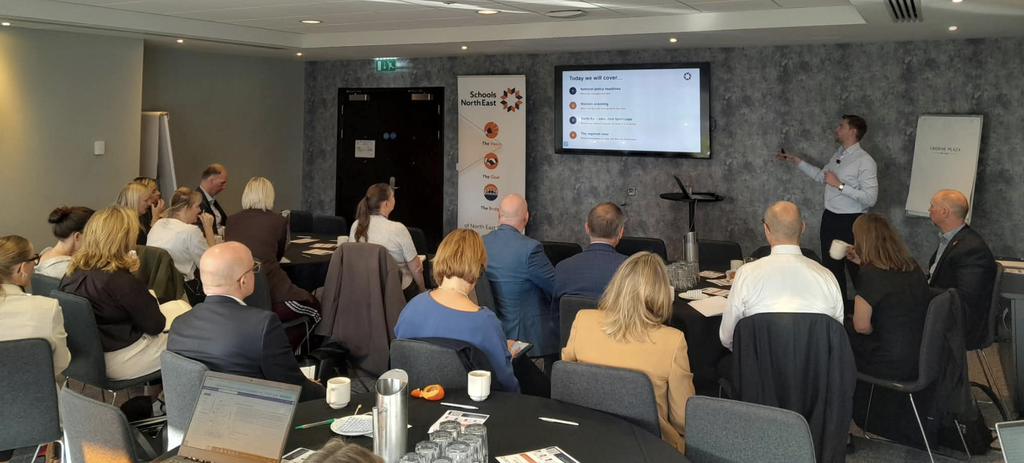
Schools North East commenced its first Policy Briefings of the academic year yesterday (17 September), bringing school and trust leaders together in Middlesbrough and Newcastle.
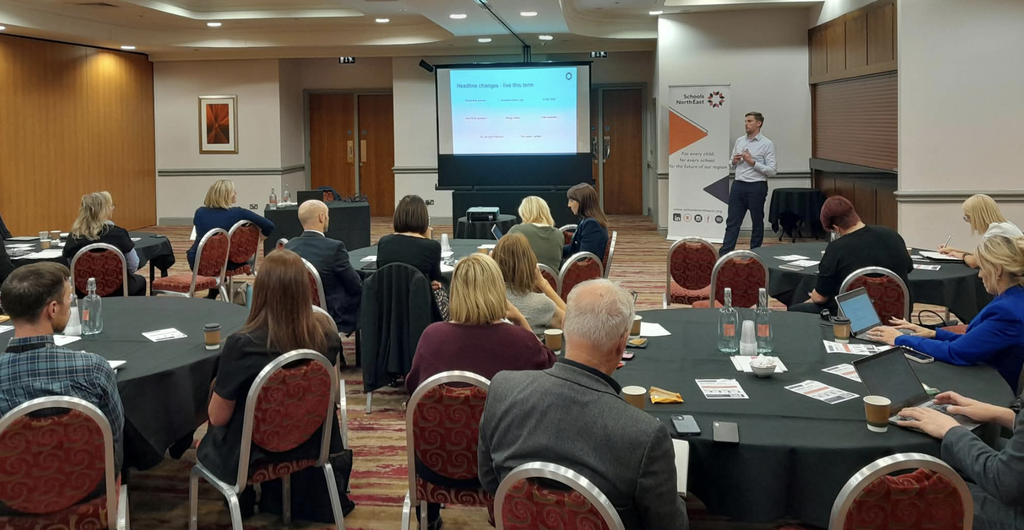
Led by Schools North East Policy Manager Ben Hardy, the sessions gave Partner Schools and Trusts an opportunity to hear about the latest developments in national education policy, look ahead to changes coming over the next two years, and consider what they could mean specifically for schools in our region.
These are the first in what will become a regular series for our Partner Schools and Trusts. We know how busy you all are, and the aim is very simple: to give you a regular opportunity to step away from the day-to-day, hear what is happening in policy, what we think it means for schools and trusts in the North East, and what Schools North East is doing about it on your behalf.
Just as importantly, the briefings gave leaders the chance to share what they are seeing in their own schools and communities, helping to shape our ongoing policy work and representations to government. They also provided valuable time for colleagues to network, strengthen relationships and connect with colleagues from across the region.
The ‘structural divide’: putting the North East context first
At the heart of both briefings was an issue Schools North East has consistently raised nationally: the ‘structural divide’ facing children, families and schools in our region.
Schools and trusts do not operate as islands. Their ability to support children is affected by the strength of the services and infrastructure around them, from access to educational psychologists and speech and language therapists to health services, transport and housing.
This is why Schools North East continues to challenge narratives which look at educational outcomes without considering the very different circumstances in which our schools operate. It is an argument that is increasingly gaining attention beyond the region, including from national education and media organisations examining the structural inequalities affecting North East schools.
Our message remains clear: tackling regional educational inequality cannot be the responsibility of schools alone. National policy needs to address the strength and capacity of the wider services surrounding them.
Looking beyond the policy headlines
Schools are facing another busy year of policy change, with significant developments expected across funding, SEND, inclusion, accountability and the wider school system.
Yesterday’s briefings covered the latest position on teacher pay and school funding, changes to the Academy Trust Handbook, expansion of free school meals, the school food standards, as well as what schools should be watching for in the months ahead.
The discussion went beyond the headlines. On free school meals, for example, the expansion is expected to make around 55,000 additional children eligible in the North East. Leaders discussed the financial reality of delivering that commitment at a time when the amount schools receive per meal falls significantly below the actual cost.
New school food standards coming into force from 2027 were also examined, including the potential implications for cost, pupil uptake and food waste. Schools North East has already fed the region’s views into the national consultation on the changes.
SEND reform was a particularly important area of discussion. Schools North East’s analysis has highlighted the scale of the workforce challenge behind the government’s ambitions. Delivering the proposed benchmarks for access to ‘Experts at hand’ in the schools white paper could mean the North East requiring up to 100 additional educational psychologists by 2028/29, in a region where 107 full-time equivalent educational psychologists are currently recorded across 12 local authorities.
That raises a fundamental question which Schools North East continues to put to government: how can greater specialist support be delivered if the specialists themselves are not available? Read more about Schools North East’s response to SEND reform.
The sessions also considered changes coming further down the track, giving leaders an opportunity to start thinking about their implications before they reach the school gates.
This horizon scanning is an integral part of our Policy Briefing Updates. We want our Partner Schools and Trusts to have the earliest possible understanding of the changes that could affect them, rather than simply responding once new policies have been implemented.
A key theme running throughout both events was the need to understand education policy through a North East lens.
Access to specialist SEND support, health services, transport and wider local infrastructure all affect children and families, while levels and patterns of disadvantage vary significantly between different parts of the country. Ensuring this wider context is recognised in national policy and decision-making remains a key priority for Schools North East.
These differences matter when national policies are designed and when the performance of schools is assessed.
Schools North East continues to make the case that the circumstances facing schools in our region need to be properly understood by policymakers. This includes challenging narratives which place responsibility for deeply rooted regional inequalities solely at the door of schools.
The experiences shared by leaders at our briefings are a vital part of that work. They help us understand where national policy is creating challenges on the ground, identify unintended consequences and take evidence directly from North East schools into our conversations with government and national organisations.
Ofsted: what is the early North East picture telling us?
The new Ofsted inspection framework was another major focus of discussion across both briefings.
Analysis of published inspection reports under the new framework highlight regional differences in the awarding of grades. Across all inspected areas, the percentage of ‘Exceptional’ and ‘Strong Standard’ grades awarded in the North East is broadly in line with national averages, just over a quarter. However, over half of all London grades are ‘Exceptional’ and ‘Strong Standard’. Looking at all ‘Exceptional’ grades awarded across the country, over 50% were awarded to London schools. In contrast, in July 2024 under the previous inspection framework, North East schools had higher rates of ‘Good’ and ‘Outstanding’ schools than the England average.
A key concern relates to the failure of the new inspection framework to take into account differing school contexts. Looking at the England average, schools working in areas of higher rates of disadvantage (as measured by IDACI quintiles) were more likely to be awarded ‘Needs Attention’ or ‘Urgent Improvement’.
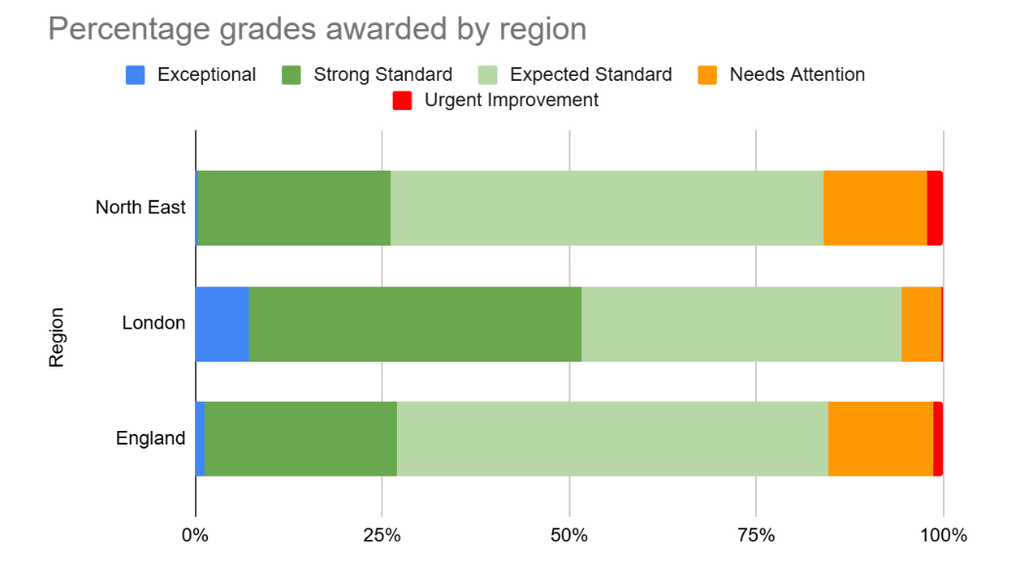
This raises important questions about how context is reflected within the new framework. In particular, we are examining whether measures used to compare similar schools sufficiently capture the different nature and impact of disadvantage in different parts of the country.
Schools North East is engaging with Ofsted on the issues being raised by North East schools and will continue gathering evidence from schools experiencing the new framework first-hand.
This is an area where hearing directly from school leaders is particularly important. The intelligence shared through our Partner School and Trust network helps us build a stronger evidence base and ensure the regional picture is heard nationally.
Bookings are also now open for our annual Ofsted Update events, taking place in Newton Aycliffe and North Shields this November. Demand is already high, so schools are encouraged to choose their venue and secure their places early for the latest updates and insights on the inspection landscape.
A North East school system that continues to change
The briefings also gave attendees a detailed look at how the structure of education in the North East itself is changing.
Nearly 60% of North East schools are now academies, while the number of academy trusts operating in the region has fallen from 129 in 2021 to 100 today. At the same time, the average size of trusts in the region has increased to 6.8 schools, compared with 5.8 nationally.
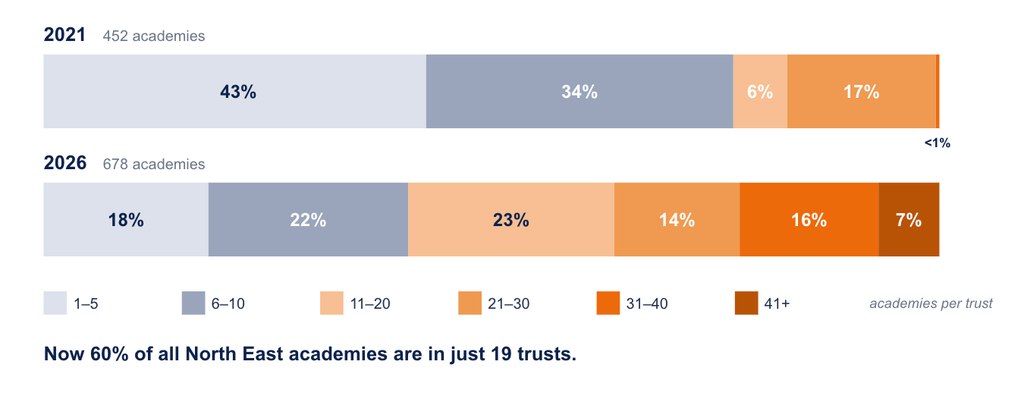
Falling pupil numbers are adding another dimension to that changing landscape, with demographic pressures increasingly affecting school finances and long-term sustainability in parts of the region.
Mission North East and the government’s wider approach to tackling educational disadvantage were also discussed. For Schools North East, the test will be whether Mission North East addresses the structural conditions behind regional inequality, rather than simply placing new expectations on schools.
Across all of these areas, our focus remains the same: understanding what national policy means in practice for North East schools and making sure decision-makers understand the consequences of the choices they make.
Continue the conversation at the Schools North East Summit
The conversation does not stop with yesterday’s briefings.
Many of the biggest issues discussed in Middlesbrough and Newcastle will be at the heart of the Schools North East Summit, where school leaders from across the region will come together with policymakers, education experts and colleagues from across the sector.
The Summit is an opportunity to step away from the day-to-day pressures of school leadership, hear the latest thinking on the issues shaping education and make sure the North East is part of the national conversation.
Book your place at the Schools North East Summit and join colleagues 500 from across the region and beyond.
Be in the room for our next Policy Briefing Update
Our Policy Briefing Updates will continue throughout the academic year as part of the programme of support available to Schools North East Partner Schools and Trusts.
They provide much more than a summary of the latest announcements. The figures and issues explored at this week’s sessions are just a snapshot of the intelligence shared with attendees. The briefings offer timely policy analysis, insight into what developments mean specifically for the North East, early warning of changes on the horizon and an opportunity to directly inform Schools North East’s policy work.
If you’re already a Partner School or Trust and couldn’t join us in Middlesbrough or Newcastle, make sure you’re in the room for the next briefing.
And if your school isn’t yet a Schools North East Partner School, becoming one means joining a network which gives North East schools a stronger collective voice, while gaining access to events and policy intelligence designed specifically for our region.
Become a Schools North East Partner School and join us at the next Policy Briefing Update.