Ofsted one year on: Is inspection recognising the realities facing North East schools?
New Schools North East research confirms that the national picture is reflected across our region: schools serving the most disadvantaged communities are significantly less likely to achieve higher Ofsted grades for achievement and attendance and behaviour. With the North East having the highest proportion of schools serving disadvantaged communities of any English region, the implications are particularly stark. This is a regional inequality that cannot be ignored.
The findings were shared at Schools North East’s annual Ofsted Update North and South events, bringing together Head Teachers, trust leaders, Ofsted representatives and education experts to reflect on the first year of the renewed inspection framework and consider what needs to change.

A central highlight was the launch of Inspection in Practice: Context, Disadvantage and the ‘Structural Divide’, presented by Ben Hardy, Policy Manager at Schools North East.
Drawing on 137 survey responses covering 309 North East schools, alongside analysis of 190 inspection reports and 10 in-depth interviews, the research explored whether inspection is providing a fair and accurate picture of schools and the communities they serve.
The findings are particularly significant for the North East, where four in ten schools have at least 40% of pupils eligible for free school meals, almost double the national figure of 23%.
Among the schools analysed, just 24% of those with the highest levels of disadvantage received Strong or Exceptional grades for attendance and behaviour, compared with 58% of schools with the lowest levels. For achievement, the figures were 12% and 30% respectively.
Yet schools serving the most disadvantaged communities were at least as likely to receive higher grades for inclusion, highlighting the strengths of schools working in challenging circumstances and raising important questions about how context shapes inspection judgements.
There were encouraging early signs of change. Since inspectors gained access to similar-schools data in September, 6 of the 14 high-disadvantage schools inspected have been graded Strong for attendance and behaviour (43%), compared with 21% of those inspected before. While based on a small sample, this could represent an important development for North East schools if the trend continues.
Beyond the grades, the research also revealed concerns about consistency and the impact of inspection on school leaders. While 31 of 44 inspected leaders considered their report cards accurate, 24 lacked confidence that another inspection team would reach the same grades.
Meanwhile, 64 of 69 leaders awaiting inspection reported that the uncertainty was harming their wellbeing.
One Head Teacher described the experience: “Waiting each Monday has been awful… the waiting and the unknowing is awful for me and my staff.”
National developments and the case for change
Alongside the research, ASCL’s Andy Jordan, Inspection and Accountability Specialist, and Tom Middlehurst, Deputy Director of Policy, explored emerging national trends, changes to Ofsted’s toolkit and developments in complaints procedures.
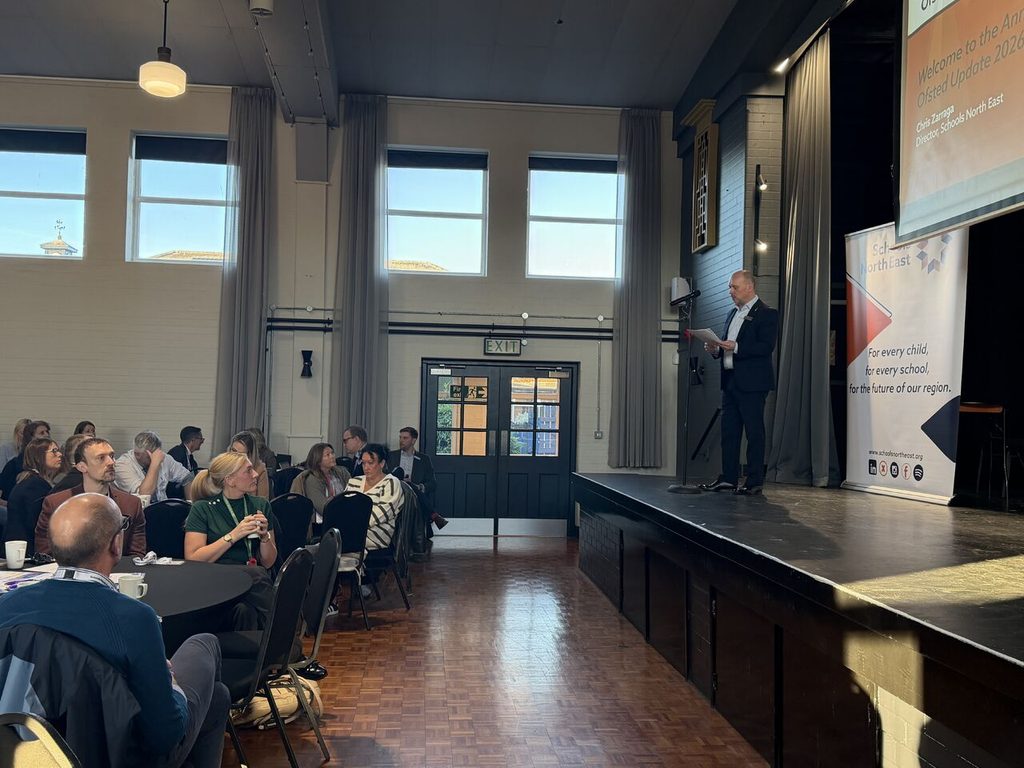
The session also highlighted ASCL’s campaign for change, including calls for advance notification of inspection, removing the ‘secure fit’ approach and reconsidering national-average benchmarks.
Understanding the renewed inspection framework
Delegates heard firsthand experiences from school-leader panels, while James Duncan, Ofsted Assistant Regional Director, provided an Ofsted perspective and an opportunity for school leaders to engage directly with the inspectorate.
For schools still awaiting inspection, practical messages included demonstrating how they respond to their particular circumstances, using professional dialogue to challenge interpretations and ensuring sufficient leadership support throughout the process.
Taking the findings forward
Schools North East will now take its research to Ofsted, government ministers and North East MPs, calling for greater transparency in how context shapes judgements, more consistent and proportionate inspections, and stronger protections for school leaders.
The full report will be published next week, providing further analysis and recommendations to inform our ongoing engagement with Ofsted and policymakers.
The events reinforced a central message from Schools North East’s wider policy work: recognising the structural challenges facing our region must go hand in hand with recognising the exceptional work taking place within its schools.
Thank you to everyone who made this year’s Ofsted Update events such a success. Across two days, delegates had the opportunity to hear valuable insights, share experiences and connect with colleagues from across the region. Our thanks go to all our speakers, exhibitors LLM Global and LionbridgePR, and everyone who attended and contributed to the discussions.
We look forward to seeing you again at our Annual General Meeting on 26 November and our Academies Conference 2027 on 21 January.