
Ofsted, disadvantage and the North East: What are we seeing so far?
Recent national coverage in Schools Week and Tes has begun to explore a potential link between Ofsted outcomes and levels of disadvantage under the new framework. Early analysis suggests a pattern: schools with higher levels of disadvantage (or lower prior attainment) may be more likely to receive lower achievement grades.
But what does this look like in the North East?
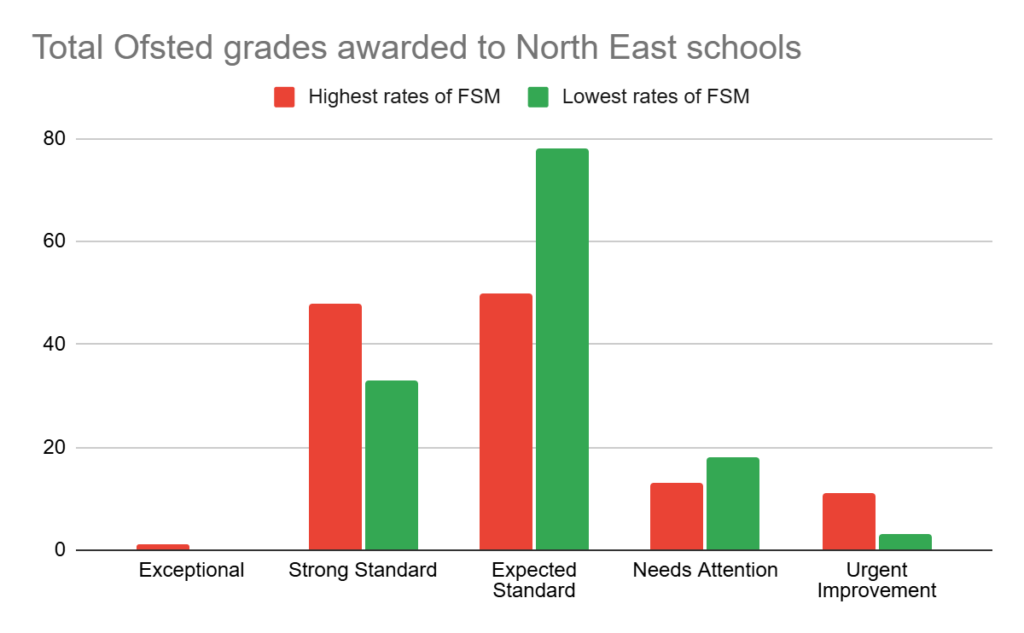
Using the 38 published Ofsted reports for North East schools to date, we’ve taken a closer look at how outcomes compare when grouped by levels of disadvantage. The 38 schools were split into two groups of 19 based on their Free School Meals rates.
A region with high disadvantage across the board
Of course, it’s important to start with context. Even within the “lowest FSM” group for North East schools with a published inspection report, levels of disadvantage remain relatively high. FSM rates in this group range from 0% to 49%, while the highest FSM group ranges from 49.3% to 89.3%—meaning many schools the lowest FSM group and all schools in the highest FSM group sit above both the national average (25.7%) and the North East average (32.3%).
This is not a comparison between affluent and disadvantaged schools, but instead a comparison within a region where disadvantage is a significant and consistent factor.
What the early patterns suggest
Although this is a small sample size, some early trends are emerging:
- Schools in the lower FSM group tend to cluster around the middle (expected standard), with no schools currently receiving the highest or lowest judgements.
- Schools in the higher FSM group show a wider spread of outcomes, including both strong/exceptional grades and needs attention/urgent improvement.
In other words, higher disadvantage does not point in a single direction. Instead, it appears to be associated with greater variability in outcomes.
A note on the data
Naturally, there are some important caveats to keep in mind:
- The dataset is still small (38 schools) and evolving.
- The number of grades awarded differs between groups, as not all schools include early years or post-16 provision.
- Both groups contain schools with relatively high levels of disadvantage, limiting direct comparison with national patterns.
What this means
At this early stage, the North East picture adds nuance to the national narrative. While disadvantage may be a factor in outcomes, it is not deterministic. The presence of both high and low judgements within the most disadvantaged group highlights the complexity of the system, as well as the risk of drawing simple conclusions.
As more inspection reports are published, a clearer picture will emerge. For now, this reinforces the importance of continuing to interrogate how the framework interacts with context, and ensuring that regional realities are fully understood in national discussions.
At Schools North East, we play a vital role as the Voice, Glue and Bridge for schools across the region, bringing leaders together, connecting insight, and ensuring a strong, collective voice is heard nationally. As always, we will continue to work closely with our network to support schools in navigating these changes, champion regional perspectives, and influence the direction of policy in a way that reflects the realities of the North East.